The Best Ceramic Bakeware

Ceramic bakeware is some of the best bakeware you can use in the kitchen. What is it, why does it work so well, and what can you get for your money?
Compare Products
- Friedokra Score10.0
FriedOkra scores from 0 to 10 are automatically scored by our AI consumer report tool based on the data collected. This score has no relationship or impact from any manufacturer or sales agent websites. Read more
- BrandLe Creuset

- Friedokra Score9.6
FriedOkra scores from 0 to 10 are automatically scored by our AI consumer report tool based on the data collected. This score has no relationship or impact from any manufacturer or sales agent websites. Read more
- BrandLarder & Vine


- Friedokra Score9.6
FriedOkra scores from 0 to 10 are automatically scored by our AI consumer report tool based on the data collected. This score has no relationship or impact from any manufacturer or sales agent websites. Read more
- BrandLarder & Vine

- Friedokra Score9.6
FriedOkra scores from 0 to 10 are automatically scored by our AI consumer report tool based on the data collected. This score has no relationship or impact from any manufacturer or sales agent websites. Read more
- BrandLarder & Vine

- Friedokra Score9.4
FriedOkra scores from 0 to 10 are automatically scored by our AI consumer report tool based on the data collected. This score has no relationship or impact from any manufacturer or sales agent websites. Read more
- BrandLe Creuset


- Friedokra Score9.0
FriedOkra scores from 0 to 10 are automatically scored by our AI consumer report tool based on the data collected. This score has no relationship or impact from any manufacturer or sales agent websites. Read more
- BrandLe Creuset

- Friedokra Score9.0
FriedOkra scores from 0 to 10 are automatically scored by our AI consumer report tool based on the data collected. This score has no relationship or impact from any manufacturer or sales agent websites. Read more
- BrandCorningWare


Last update on 2024-01-08 / Affiliate links / Images, Product Titles, and Product Highlights from Amazon Product Advertising API
Ceramic bakeware is oven cookware that is made by being fired in a kiln using a glaze. However, it is a little more complicated than that.
1. Traditional Ceramic Bakeware (CorningWare)

When we talk about traditional ceramic bakeware, we mean cooking items such as casserole dishes and things that are put directly into the oven.
Here, we are not speaking about ceramic pans that are used on top of the stove and are designed to be a non-stick replacement for Teflon-coated pans.
When most people think about ceramic bakeware, they are often thinking of CorningWare. The original CorningWare used a glass-ceramic material that was extremely durable and could be taken directly out of the oven and put into the freezer without cracking.
This material is called Pyroceram. These types of CorningWare dishes are white and have a blue cornflower design on them.
Pyroceram briefly went out of production in 2000 due to concerns about how it was manufactured, but it is now being made again with better technologies.
Other types of CorningWare that are not made of Pyroceram are called “stoneware.” They may not be literally made of ceramic but often get bunched in with ceramic bakeware.
2. Non-Stick Ceramic Bakeware
Now, to further confuse things, you can find ceramic “non-stick” bakeware that is not full ceramic pieces, but cookware with a ceramic non-stick coating on it for use in the oven.
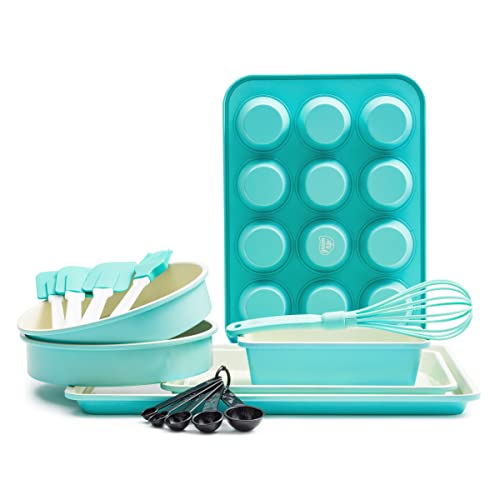
These types of ceramic “bakeware” items include cookie sheets, muffin tins, and loaf pans.
These will often be advertised as “PFOA and PTFE-free.” PFOA stands for perfluorooctanoic acid and it is a synthetic compound that repels both oil and water. PTFE is a man-made polymer that is known popularly as Teflon.
Teflon has a really bad rap these days for a lot of reasons, including the fear that cooking with Teflon can expose you to harmful chemicals.
Actually, the major problem with Teflon (aka PTFE) is how it is manufactured. The PFOA used in the manufacturing process is harmful to animals when it gets into the environment.
Non-stick cookware, not restricted to Teflon, can put off fluorines, which are bad for your health, at high heat.
However, you can avoid this health concern by not using non-stick pans for high-heat cooking, such as searing steaks.
While you may not need to worry about fluorines with ceramic non-stick frying pans, you still should avoid using them for high-heat searing.
3. Ceramic Knives

We also need to distinguish ceramic bakeware and non-stick pans from ceramic knives. Ceramic knives are made using a different process utilizing zirconia, which is also known as zirconium dioxide (ZrO2).
Zirconia is an extremely durable, hard material that makes for a good knife blade. You do not need your ceramic bakeware to be “sharp,” however, so it is unlikely you are going to find zirconium dioxide in your ceramic bakeware.
You may be starting to realize now that the more you learn about ceramic cookware, the more confusing it gets.
You will find that a lot of the marketing is also misleading or at least incomplete. You may have a hard time finding out exactly what a manufacturer means when they say something is “ceramic.”
The short answer to this dilemma is that we don’t have a single answer for you. We can offer the following guidelines:
1. Get Clear on What You Need Ceramic For
Do you want ceramic bakeware because you want a non-stick cookie sheet or muffin tin? (In this case, what you really want is a ceramic non-stick coating.)
Or, do you really want a highly durable piece of CorningWare, where you can take your steaming dish out of a blazing hot oven and put it directly into the freezer without it exploding in your face
2. Do an Inventory of Your Kitchen Stuff
You may actually have some classic CorningWare Pyroceram hidden in your basement somewhere.
Maybe your mom gave it to you and you forgot you had it. You will perhaps find you don’t need what you thought you needed, or that you are missing something you thought you had.
3. Read the Product Description Carefully
Before you buy a set of ceramic bakeware, read the product description on the website very thoroughly.
If you are not at the computer and shopping in person at, say, a department store, you may be able to read the side of the box.
You can also ask the salesperson, although you have no guarantee that they will know anything about cooking with ceramic.
What you want to look for is information on what type of ceramic cookware it is. Does it say that this is the type of ceramic that can withstand drastic changes in temperature like glass-ceramic CorningWare?
If it does not say that, do not assume that it can handle that. You do not want to test this out at home a broken piece of cookware that explodes in your face can literally land you in the hospital.
Still, you need to be careful even with the manufacturer’s claims. There has been a big problem with Pyrex glass exploding with significant temperature changes.
This did not use to happen with their old formula. However, they stopped making Pyrex in America out of borosilicate glass and started making it with soda lime silicate glass.
Despite their claims of “heat treating” it to make the soda lime silicate glass stronger, it simply is not as temperature change-resistant as the old borosilicate glass.

4. Go Through Online Reviews
Online reviews are extremely helpful in determining whether a product is halfway decent or not.
You do have to read both the really good and really bad reviews, as well as the ones in the middle. There will always be people who truly love the product and those who despise it.
When you look at an overall rating, it is more positive than negative. Do the positive reviews seem like real people with real experience with the product? Or are they overly gushing and sound a bit fake?
It is a fact that some companies will pay people to write positive reviews for their products. This is bad business and not ethical, but it happens all the time.
This is more likely to happen with some no-name brand that has not established itself as a major presence in the marketplace.
To find out if a company’s product reviews on a site such as Amazon are for real, you can try a review rating website such as Fakespot. Fakespot is not always accurate, and sometimes they miss active attempts to manipulate product reviews. But it is a starting place.
5. Compare Ceramic Bakeware Prices
You will find prices can be all over the map for ceramic bakeware. But just because something is very expensive, it does not mean the quality is necessarily better. Conversely, cheaper bakeware sets made out of ceramic are not necessarily bad.
Take a look at the prices of comparable products to see what is reasonable to pay. You can also check price comparison websites to see what might be a good deal.
6. A Note on Lead
There is some concern with certain ceramic bakeware products having excess levels of lead in them.
This is especially a concern with ceramic sets that are made in China and sold by “off” brands. Lead is a part of the ceramic-making process, so there will be a slight amount in all of them.
The FDA is supposed to monitor these amounts to ensure safe levels. If the cookware is not within those levels, it should say “for decoration only.” If you see a pot or pan that has that on it, you absolutely should not cook with it, ever.